
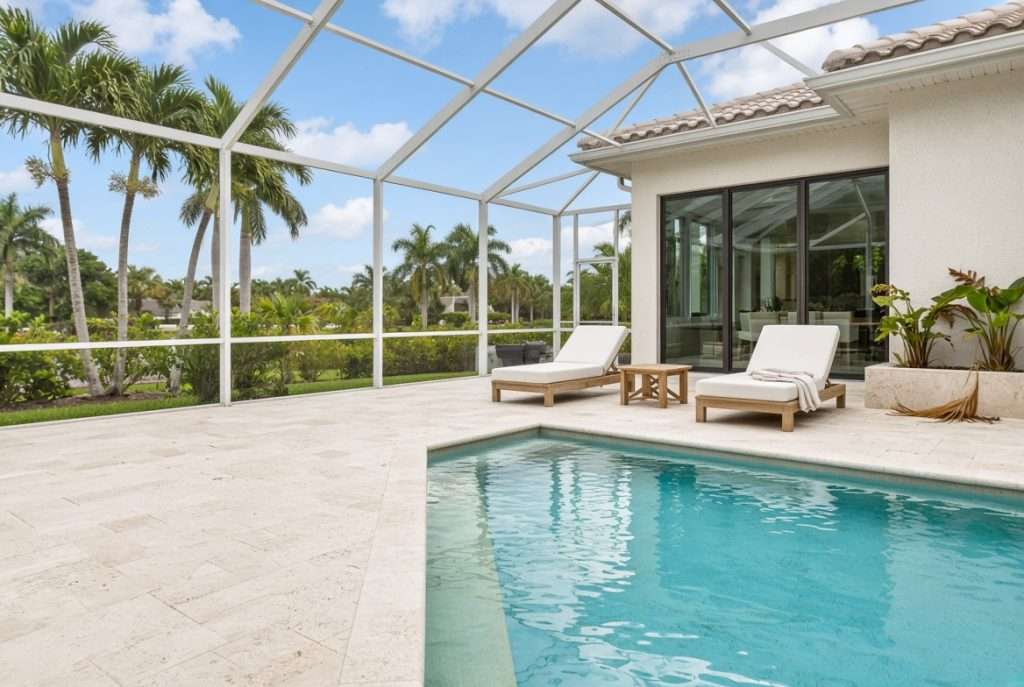
Updated September 28, 2026 | Atlantic Dreamscapes, Brevard County, Florida
Direct Answer
Color decides how hot a pool deck gets, not the material. Solar reflectance is the main driver of peak surface temperature, so light travertine, porcelain and concrete pavers land close together, while a dark finish runs hot in any of them. Material choice matters more for chemicals, texture and cost.
TL;DR
- Surface temperature tracks color, not material. Paying a premium for stone on cooling grounds is paying for the wrong variable.
- Porcelain, travertine, shellstock and concrete differ most in water absorption, chemical resistance and price, not in heat.
- Porcelain and concrete pavers each have a published specification behind them. Travertine and shellstock do not.
- Acid is the real chemical risk. Travertine and shellstock are calcium carbonate, and acid etching is permanent.
- No DCOF number certifies a pool deck. The standard leaves exterior wet surfaces to the manufacturer’s declaration.
- The base depth, compaction and edge restraint decide whether the deck is still flat in ten years.
One liner: Pick the lightest color you like in whatever material fits the budget, then spend the argument on what goes underneath it.
Key Numbers
| Figure | Value | Source |
|---|---|---|
| Effect of reflectance on surface temperature | 10 percent more solar reflectance, roughly 7F cooler | EPA, 2012 [1] |
| Peak summer surface temperature, conventional pavement | 120 to 150F | EPA, 2012 [1] |
| Porcelain water absorption | 0.5 percent or less, by definition | ANSI A137.1:2022 [2] |
| Concrete paver compressive strength | 8,000 psi average minimum | ASTM C936 [3] |
| Concrete paver water absorption | 5 percent average maximum | ASTM C936 [3] |
| Minimum compacted base, pedestrian areas | 4 inches over well-drained soil | ICPI Tech Spec 2 [7] |
| Required DCOF for an exterior pool deck | None. Manufacturer-declared | ANSI A326.3-2021 [5] |
Why Travertine Is Not Automatically the Coolest Pool Deck
In short: Color decides how hot a pool deck gets, not the material name. A light concrete or porcelain paver lands within a few degrees of ivory travertine, and a dark travertine will burn bare feet the same as anything else.
Travertine has a reputation around Brevard pools for staying cool, and the explanation you’ll hear is that the stone is porous, so heat escapes through the pores. That explanation doesn’t hold up. EPA’s cool pavements research states it plainly: solar reflectance, meaning how much sunlight a surface throws back instead of absorbing, is the main determinant of a material’s maximum surface temperature [1].
Reflectance is mostly a function of color. Pale surfaces bounce sunlight away, dark ones soak it up, and the same research found that raising a surface’s solar reflectance by 10 percent can drop its surface temperature by roughly 7F [1].
Porosity does something, but not what the pitch claims. A porous surface cools by evaporation while it’s wet. Dry, in full August sun, the extra surface area can leave it hotter than a solid equivalent, and the surface roughness can pull its net reflectance down [1].
Three things follow for a pool deck in Brevard County:
- An ivory or shell-white finish beats a walnut or noce finish in the same material, on any material.
- A light concrete paver and light travertine land close enough on heat that temperature alone doesn’t carry the price gap.
- A dark travertine is a hot deck with a stone invoice attached.
We set travertine on plenty of Brevard pool decks, and it’s often the right call for how it looks and how it wears. It’s the wrong call when the only reason for paying the premium is the cooling promise.
Travertine vs Porcelain vs Concrete vs Shellstock for a Florida Pool Deck
In short: Porcelain absorbs the least and cares the least what gets spilled on it. Travertine and shellstock are both limestone, so both are porous and both react to acid. Concrete pavers are the value pick, and they’re the only one of the four with a strength number you can hold a manufacturer to.
| Material | Typical color range | Water absorption | Reaction to pool chemicals | Repair | Relative cost |
|---|---|---|---|---|---|
| Porcelain | Full range, light to dark | 0.5 percent or less by definition [2] | Inert. Chlorine, salt and acid do nothing to it | Lift and replace the unit | Highest |
| Travertine | Ivory through walnut | Porous, no single published figure | Calcium carbonate, so acid etches it [4] | Lift and replace the unit | High |
| Shellstock | Cream and tan, light by nature | Porous and open structured | Calcium carbonate, etches and absorbs [4] | Lift and replace, matching is harder | High |
| Concrete paver | Full range, fades over years | 5 percent average maximum under ASTM C936 [3] | Resists chlorine, can spall with heavy salt exposure | Lift and replace the unit | Lowest |
Two of these four materials come with a published specification behind them and two do not. That gap matters more than most of the marketing does.
Porcelain is not a description, it’s a threshold. ANSI A137.1 defines porcelain tile as tile with water absorption of 0.5 percent or less, measured by ASTM C373 [2]. A unit that misses that number is ceramic, whatever the showroom label says. Concrete pavers have their own standard: ASTM C936 requires an average compressive strength of at least 8,000 psi with no single unit below 7,200 psi, and average absorption no greater than 5 percent [3].
Travertine and shellstock have no equivalent number. They’re natural stone, quarried rather than manufactured, and their porosity changes from quarry to quarry and sometimes from pallet to pallet. Both are calcium carbonate, which is why both etch when acid touches them [4]. Around a pool that gets acid washed, that’s a real consideration and not a theoretical one.
One trap worth naming. Unfilled travertine has open holes in the face. They look good in a showroom and they hold water, sand and sunscreen residue next to a pool. Filled and honed travertine costs a little more and stays cleaner.
The paver format itself is the quiet advantage across all four rows. A damaged unit lifts out and a new one drops in. A cracked concrete slab gets patched, and the patch shows for the life of the deck.
Sizes, Layout and Cut Waste
Most pool deck pavers come in 12×24, with 16×24 and larger formats available. Travertine is often sold as a French pattern, a repeating mix of four sizes that suits a natural stone look. Format changes cost as well as appearance. A rectangular deck run in 12×24 wastes little. A freeform pool turns every perimeter piece into a cut, and the offcuts go in a skip, so the material you buy exceeds the square footage you measured.
If barefoot comfort leads, pick the lightest color in whichever material fits the budget. If low maintenance leads, porcelain. If budget leads, a light concrete paver does most of what travertine does for less. You can see pool decks we have built across the county.
Slip Resistance on a Wet Pool Deck: Texture, Slope and What to Ask For
In short: No DCOF number certifies a pool deck as safe. For an outdoor deck the standard hands the call to the manufacturer, so what you’re actually specifying is texture, drainage and a declared use class.
You’ll see pages quote 0.42 or 0.50 as the safe threshold for a pool deck. Those figures come from interior categories. ANSI A326.3 sorts hard surface flooring into five product use classifications, and an outdoor pool deck sits in Exterior Wet. The criterion for Exterior Wet is manufacturer-declared, with no DCOF value attached to it at all [5]. The Tile Council of North America, which develops the standard, states that slip resistance and DCOF are not synonymous terms [5].
So ask for three things instead of a number.
A declared use class. Ask the supplier whether the product is declared for Exterior Wet. That declaration is a manufacturer putting their name to where the product belongs, based on their own testing and experience [5].
Texture you can feel. Tumbled travertine, structured porcelain, shot-blast concrete. Wet a sample and run a hand across it before you pick.
Drainage. The standard’s own list of what affects a slip includes how drainage takes place when liquids are involved [5]. Water that leaves the surface can’t be slipped on. A pool deck should be pitched away from the water, and that pitch gets set during base prep, not after the pavers are down.
One caution worth stating plainly. No surface is slip proof when it’s wet and carrying sunscreen. Slip resistant is the honest word, and it’s the only one anyone can support.
Chlorine, Salt and Acid: What They Do to a Paver Deck
In short: Balanced pool water doesn’t harm any of the four materials. Acid does, and it hits travertine and shellstock hardest, because both are calcium carbonate.
Chlorine. At the concentration a pool runs, chlorine that reaches the deck as splash is diluted and does little. The risk is concentrated product. A tablet or a slug of undiluted liquid left sitting on a paver can bleach the pigment out of that spot. Keep product off the deck and rinse spills.
Acid. This is the one that matters. Travertine and shellstock are calcium carbonate, and acid dissolves calcium carbonate [4]. Muriatic acid turns up around pools for washing the shell and clearing scale, and wherever it runs onto a limestone deck it leaves a dull etched patch. That mark isn’t a stain sitting on the surface, it’s stone that’s gone, and cleaning won’t bring it back. Porcelain ignores acid entirely. Concrete pavers sit in between.
Salt. The honest answer is that this one is stated with more confidence than the evidence supports. Salt reaches the deck by splash and concentrates as the water evaporates, and porous stone is agreed to be the vulnerable part, but we could not find a study or a manufacturer position that pins down how much damage a residential salt system does to a deck over what period. The precaution costs nothing: rinse the deck with fresh water at the end of a swim day, and pay attention to the splash zone and the coping rather than the whole deck.
Separately, and not a chemical problem at all: efflorescence. New concrete pavers can develop a white haze as calcium hydroxide inside the unit migrates to the surface and reacts with carbon dioxide in the air to form calcium carbonate. It looks alarming and it doesn’t compromise the paver’s structural integrity or indicate a defective product [6]. It dissipates with weather and time.
Sealing helps with all of this, and sealing is protection with an expiry date rather than a permanent fix. Our paver restoration and sealing work covers that side of it.
Pool Coping: What It Does and How to Match It to the Deck
In short: Coping caps the edge of the pool shell, gives a swimmer something to grip, and steers splash away from the deck field. It’s a separate decision from the deck material, and it takes more abuse than anything else out there.
Coping is the band of units that finishes the pool’s edge. It’s usually mortar set onto the bond beam, while the deck field sits on a sand bed over compacted base. The two are built differently, so they age differently and they get repaired differently. A settled deck can be lifted and reset without touching the coping, and damaged coping can be replaced without rebuilding the deck around it.
Because coping sits in the splash zone, it takes more chemical contact, more salt and more wetting and drying than anything else on the deck. That makes it the piece to spend on and the piece to rinse.
On matching, a deliberate contrast ages better than a close match. Two materials chosen to look identical drift apart as they weather, and that drift shows more than a contrast ever would.
Coping selection is its own subject and deserves a longer conversation than this page has room for.
The Base Under the Deck Decides How Long It Lasts
In short: A paver pool deck is a system, and the pavers are the part you can see. Base depth, compaction and edge restraint decide whether it’s still flat in ten years.
Built properly, the sequence runs like this:
- Excavate, then compact the soil subgrade.
- Lay geotextile where the subgrade calls for it. Optional, and worth it over fine or damp soils [7].
- Spread and compact the aggregate base. ICPI’s minimum for a patio or pedestrian area over well-drained soil is 4 inches after compaction, and weak or continually wet soils want more [7].
- Build the edge restraint onto the finished base, not onto the bedding sand [7].
- Screed the bedding sand to about an inch. Washed, correctly graded sand, never stone dust or waste screenings [7].
- Set the pavers.
- Sweep sand into the joints and compact the field so the units lock together.
Step 4 is the one that goes missing. Edge restraints are what hold the pavers and joint sand together so the field stays interlocked [7], and a deck without them spreads at the perimeter and opens its joints over a few seasons. Nothing about that is visible on handover day.
Brevard’s sandy soil helps here, because it drains. It’s still subgrade, not base, and it has to be compacted rather than built on as found.
Reading a quote is easier than reading a deck. Three things should appear in writing: the base depth, how it gets compacted, and edge restraint as its own line item. A quote that names all three is from someone who intends to do the work. See how we approach paver installation across Brevard County.
Paver Pool Deck Cost: What Moves the Number
In short: No single range covers every Brevard pool deck, because on a rebuild the pavers are often the smaller half of the job. What moves the price is what sits under the old deck, how much of it has to come out, and how hard the backyard is to reach.
| Driver | What it does to the price |
|---|---|
| Square footage | Sets the floor. Most other costs scale off it |
| Material | Concrete pavers lowest, travertine and shellstock higher, porcelain highest |
| Tear-out of the existing deck | Often the largest single swing on a rebuild. Breaking and hauling a concrete slab is labor and disposal before one paver goes down |
| Base and subgrade condition | Settled or poorly drained ground means more excavation and more aggregate |
| Drainage work | Deck drains or regrading are added scope, not part of the paving |
| Coping | Priced separately, set in mortar, and the splash zone piece worth spending on |
| Pool shape | Curves mean cuts, cuts mean waste, and waste means more material than the square footage implies |
| Access | A backyard reachable only through a narrow side gate turns machine work into wheelbarrow work |
| Permit | Depends on the address. Brevard has unincorporated county areas plus incorporated cities that run their own building departments, so no single countywide answer holds. Confirm with the department covering your property before work starts |
The quote to be careful with is the cheapest one that doesn’t state a base depth. That saving is real on the day you sign it, and you spend it again in year three lifting and resetting a deck that settled. What you’re buying under a paver pool deck is mostly the part you never see. When you’re ready, get a quote on your deck.
Frequently Asked Questions
What is the coolest pool deck paver material?
The lightest colored one. Solar reflectance is the main determinant of a surface’s maximum temperature, and reflectance tracks color far more closely than it tracks material. Ivory travertine, light porcelain and light concrete pavers all land near each other. A dark finish in any of the three runs hot. [1]
Can you lay pavers over an existing concrete pool deck?
Sometimes. It works when the slab is sound, still drains away from the pool, and the added height doesn’t foul the coping, a threshold or a door swing. A slab with moving cracks will telegraph them upward. ICPI guidance for paving over a concrete base calls for weep holes at the low points so water doesn’t sit in the bedding layer. [8]
Are travertine pool decks slippery when wet?
Travertine has natural texture and a tumbled finish adds more, which helps. No material is slip proof when it’s wet. ANSI A326.3 sets no DCOF value for exterior pool decks and leaves the classification to the manufacturer, so ask about the finish and about how the deck drains rather than asking for a number. [5]
Do pool chemicals damage paver decks?
Balanced pool water doesn’t. Acid does. Travertine and shellstock are calcium carbonate, so acid etches them permanently. Concentrated chlorine left sitting on a paver can bleach the pigment. Porcelain is unaffected by all of it. Salt gets blamed frequently, and the evidence for how much it actually does is thin. [4]
Is there a DCOF number a pool deck has to meet?
Not in the current standard. ANSI A326.3-2021 classifies exterior wet surfaces as manufacturer-declared, with no DCOF value attached. The 0.42 figure people quote comes from the 2017 version and applies to level interior floors walked on when wet. Some swimming pool codes still reference that older version. [5]
Does Florida code set a minimum slope for a pool deck?
The 2 percent figure people quote comes from Section 454.1 of the Florida Building Code, which covers public swimming pools and bathing places. A backyard pool is regulated under Section 454.2 instead. Water still has to run away from the pool, and any competent build pitches it that way, but that particular number is borrowed from rules written for public pools. [9]
Definition Bank
| Term | Definition |
|---|---|
| Solar reflectance | The share of sunlight a surface throws back rather than absorbing. Also called albedo. |
| DCOF | Dynamic coefficient of friction. A measured comparison of grip between surfaces, not a prediction of slipping. |
| Manufacturer-declared | A classification the maker assigns from its own testing and experience, used where the standard sets no numeric threshold. |
| Calcium carbonate | The mineral that makes up limestone, travertine and shellstock. Acid dissolves it. |
| Travertine | A banded carbonate stone formed by mineral deposition, sold in finishes from ivory to walnut. |
| Shellstock | Fossil-shell limestone, also sold as shellstone or coquina. Porous, light in color, varies by quarry. |
| Porcelain paver | A ceramic paving unit meeting a 0.5 percent water absorption threshold. |
| Coping | The band of units capping the pool shell edge, usually mortar set. |
| Compacted aggregate base | The crushed stone layer under the deck that carries the load and controls settlement. |
| Bedding sand | The screeded sand layer the pavers sit on, roughly an inch thick. |
| Edge restraint | The perimeter member holding pavers and joint sand together so the field stays interlocked. |
| Subgrade | The native soil under the base. In Brevard, usually sand. |
| Efflorescence | White haze on new concrete pavers as calcium hydroxide migrates out and forms calcium carbonate. Harmless and temporary. |
| Tumbled finish | A stone surface abraded to soften edges and add texture, which helps wet traction. |
| Unfilled travertine | Travertine with its natural voids left open, which hold water and grit around a pool. |
Sources
- U.S. Environmental Protection Agency. Cool Pavements, Chapter 5 of Reducing Urban Heat Islands: Compendium of Strategies. 2012.
- Tile Council of North America. ANSI A137.1:2022, Specifications for Ceramic Tile. Porcelain defined by water absorption per ASTM C373. Accessed 2026.
- ASTM International. ASTM C936/C936M, Standard Specification for Solid Concrete Interlocking Paving Units. Accessed 2026.
- Geology reference on coquina and carbonate rock composition. Accessed 2026.
- Tile Council of North America. Dynamic Coefficient of Friction FAQ, reproducing Table 1 of ANSI A326.3-2021. Accessed 2026.
- Interlocking Concrete Pavement Institute. Tech Spec 1, Glossary of Terms for Segmental Concrete Pavement. Accessed 2026.
- Interlocking Concrete Pavement Institute. Tech Spec 2, Construction of Interlocking Concrete Pavements. Accessed 2026.
- Interlocking Concrete Pavement Institute. Tech Spec on concrete paving slabs and planks, covering installation over a concrete base. Accessed 2026.
- Florida Building Code, Section 454, Swimming Pools and Bathing Places (Public and Private). Section 454.1 governs public pools; Section 454.2 governs private and residential pools. Accessed 2026.