
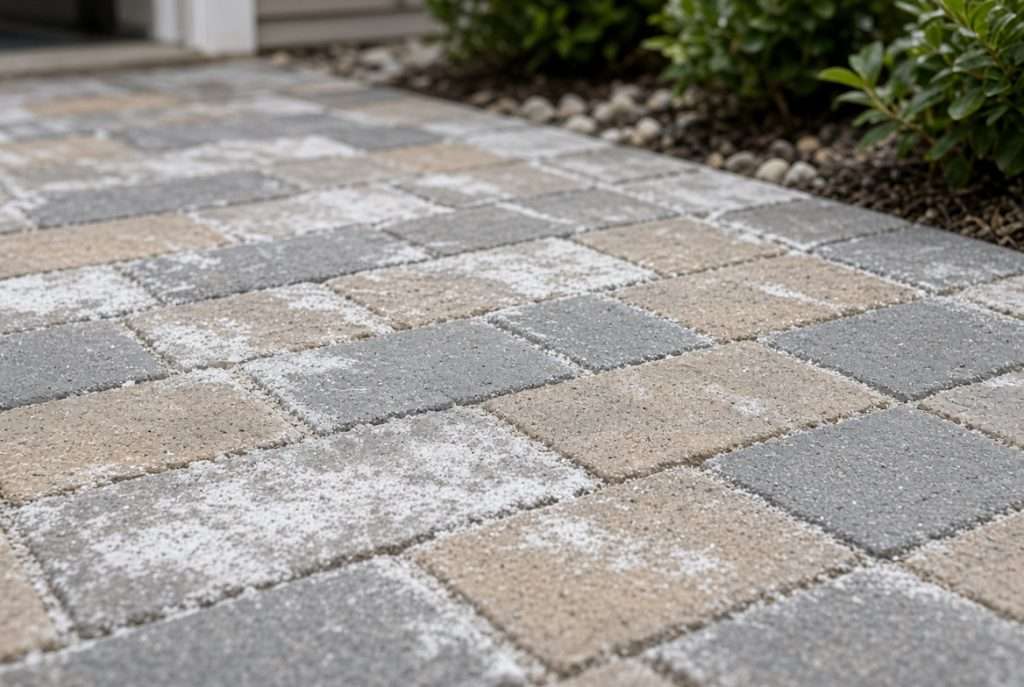
You walk out to the pool deck on a Saturday morning and there it is. A chalky white film across pavers that looked perfect a few months ago. Your first instinct is to grab something from the garage and scrub it off.
Hold off on that for a minute. White haze on pavers isn’t one problem. In Brevard County, it’s usually one of four, and they look nearly identical from six feet away. The fix for one of them can permanently damage pavers suffering from another.
Quick answer: White on pavers usually comes from efflorescence (salts moving out of the concrete), mineral deposits from irrigation water, sea salt residue in beachside areas, or moisture trapped under a sealer. Each has a different cause and a different treatment. Telling them apart before you clean is what protects the surface.
Below we walk through all four, plus a simple four-point check you can run yourself in about ten minutes. If what you find points to a sealer issue or a drainage problem, that’s the point where professional paver cleaning and sealing stops being optional.
Cause 1: Efflorescence, When the Salt Comes From Inside the Paver
This is the one most people have heard of, and it’s the most common on newer installs.
Concrete pavers are made with Portland cement. When cement hardens, it produces calcium hydroxide. Water moving through the tiny capillaries inside the paver dissolves that calcium hydroxide and carries it up to the surface. There it reacts with carbon dioxide in the air and turns into calcium carbonate. Once the water evaporates, the white is left behind.
That mechanism is documented by the Concrete Masonry & Hardscapes Association, the trade body formed when the Interlocking Concrete Pavement Institute merged with the National Concrete Masonry Association.
A few specifics worth knowing:
- CMHA states efflorescence does not affect the structural performance or durability of concrete pavers
- It can show up immediately or months later, and may peak as early as 60 days after installation
- If your pavers went down during a dry stretch, it may take the next wet season to appear at all
- Dark pavers show it more than light ones, which is why a charcoal driveway can look dramatic while a tan patio next door looks fine
- The older ICPI consumer guide on efflorescence puts the typical window at roughly 18 to 24 months before it stops developing, once the available calcium hydroxide runs out
Manufacturers add admixtures to reduce the odds, but CMHA is clear that eliminating it entirely isn’t possible. It’s a natural byproduct of curing concrete.
The one test that separates efflorescence from everything else
Wet the surface with a hose, then watch it dry.
According to the ICPI consumer guide on managing efflorescence, when the pavers are wet the white disappears and the color actually looks richer. As they dry, the haze comes back. That behavior is specific to efflorescence. A sealer problem doesn’t respond to water that way.
Cause 2: Mineral Deposits From Your Irrigation Water
Here’s the one almost nobody checks first, and in this county it’s a real contender.
Brevard’s water carries dissolved minerals. The City of Melbourne’s 2026 Annual Drinking Water Quality Report, covering 2025 sampling, lists sodium detected at 104 ppm, with likely sources given as saltwater intrusion and leaching from soil. The city blends treated surface water from Lake Washington with water from four Floridan Aquifer wells, and the report describes that well water as brackish before reverse osmosis treatment.
Every time a sprinkler head throws water across a driveway or patio, that water evaporates and leaves its mineral load on the surface. Do that two or three times a week for a year and you get scale.
The Brick Industry Association includes poorly directed landscape sprinklers in its troubleshooting list for white deposits on masonry, in Technical Note 23A.
The reclaimed water factor is specific to this area. Brevard County Utility Services supplies reclaimed water for irrigation across Viera, Rockledge, Merritt Island and parts of north Melbourne. The county states reclaimed water isn’t metered, so there’s no limit on its use, and the City of Melbourne notes reclaimed water isn’t subject to the year-round restrictions that apply to potable water and private wells.
More cycles means more evaporation events on your hardscape. That’s the whole mechanism.
One detail that tells you the industry takes this seriously: CMHA instructs contractors to shut off all automatic sprinkler systems during cleaning, sealing, and drying. Irrigation is treated as active interference with a paver surface, not background noise.
Your rain sensor is a legal requirement, and a suspect
Florida Statute 373.62 requires anyone operating an automatic landscape irrigation system to properly install, maintain, and operate technology that stops the system during periods of sufficient moisture. A second subsection requires a licensed contractor working on the system to test each of those devices. UF/IFAS notes Florida is one of only a handful of states with a rain sensor law on the books.
A dead sensor means your system runs after storms. On a paver driveway, that’s extra evaporation cycles you never asked for.
Current St. Johns River Water Management District rules for Brevard (watering restrictions here):
- No irrigation between 10 a.m. and 4 p.m.
- Two days per week during daylight saving time, one day per week during Eastern Standard Time
- No more than three-quarters of an inch per zone, and no more than one hour per zone
- The restrictions apply to private wells and pumps, not just utility water
Worth knowing: the District currently has a Phase III Extreme Water Shortage declared for portions of several counties to the north. Brevard isn’t included and follows standard restrictions. Under a Phase III declaration the District applies extra limits to activities including pressure washing, so it’s sensible to check the District’s current status before scheduling any exterior work.
Cause 3: Salt Residue if You’re East of the Indian River
If you’re in Satellite Beach, Indialantic, Indian Harbour Beach, or east Merritt Island, salt spray is its own category.
The Brick Industry Association’s Table 1 in Technical Note 23A lists common sources of white deposits by chemistry. Sodium chloride is attributed to seawater. That’s a separate compound from the calcium carbonate that shows up in efflorescence, which BIA attributes to mortar and concrete.
Published research backs the distance pattern. Studies on airborne chloride deposition find the rate drops off exponentially as you move inland from the coastline. Work published in Materiales de Construcción on a Brazilian coastal site recorded a sharp reduction in marine aerosol chloride within roughly the first 200 meters, about 650 feet, from the water. Research summarized by ScienceDirect also notes that concrete facing the sea without any shielding picks up noticeably more chloride than surfaces that are blocked or turned away.
That’s why we see pool deck pavers with a white east-facing edge and a clean west-facing edge on the same slab. The wind direction draws the line.
CMHA notes that silane and siloxane sealers reduce chloride entry and offer added protection for pavers exposed to salt air, and are useful around pool decks to limit degradation from chlorine. A beachside deck and an inland driveway aren’t the same job.
Cause 4: Moisture Trapped Under a Sealer
This is the cause with the highest stakes, and the one that’s least understood.
CMHA lists four conditions under which pavers will pull efflorescence to the surface or the sealer itself will whiten:
- The surface and joints weren’t dry when the sealer went on
- The pavers hadn’t had enough exposure to moisture before sealing
- There’s a source of salts under the pavers, in the bedding sand, base, or soil, migrating up through the joints
- The sealer isn’t breathable, so moisture can’t move through and evaporate
CMHA adds that if the base drains poorly, if the sealer is applied over saturated joint sand, or if it’s applied too thick, the sealer can go cloudy. At that point it has to be removed or re-dissolved. There’s no rinsing it off.
Prep requirements are strict for a reason. CMHA says all dirt, oil, and efflorescence must be removed before sealing, and calls for at least 24 hours with no moisture or surface dampness before application. A separate CMHA tech note goes further and recommends waiting through a wet season before sealing, so the efflorescence can work its way out of the concrete first.
The part that turns a cosmetic issue into a real one
Here’s the finding that changes how you should think about sealing.
The Brick Industry Association reports that when water and dissolved salts move toward a coated surface, they can get stopped roughly one-eighth to one-quarter of an inch below the surface. The water passes through as vapor, but the salts get deposited inside the unit. BIA calls this cryptoflorescence, or subflorescence, and states these salts can build enough pressure inside masonry to cause spalling.
Source: Brick Industry Association, Technical Note 23A, June 2019
BIA’s conclusion is direct: coatings are not recommended as the sole treatment for efflorescence problems.
So the honest answer to “does sealing cause white haze or fix it” is both, and prep decides which. Seal a clean, dry, settled surface with a breathable product and you protect it. Seal over an active moisture problem and you can move the damage from the surface into the paver.
That’s also why the sealer we use at Atlantic Dreamscapes, a two-part urethane color-enhancing product, comes after pressure washing and re-sanding with fractured angular sand, never before. CMHA notes urethanes can’t simply be re-coated to fix a problem underneath. The surface has to be right the first time.
Not sure which of the four you’re looking at? A site visit settles it in one appointment. Call Atlantic Dreamscapes at 321-704-3943 and we’ll take a look before anything gets applied to your pavers.
The Atlantic Dreamscapes Four-Point White Check: Wet, Rinse, Map, Clock
You can narrow this down yourself before anyone comes out. Four observations, no chemicals.
Check | What to do | What it points to |
Wet | Hose the surface, then watch it dry | White vanishes when wet and color looks richer, then haze returns dry: efflorescence. White stays milky wet or dry: sealer problem |
Rinse | Plain water rinse, then check again over the next week | Sodium chloride from sea spray is highly water soluble and rinses off. Carbonate deposits from cement and hard water don’t. If it clears with water and returns after windy days: coastal salt |
Map | Note exactly where the white sits | Fan or arc bands matching a sprinkler throw: irrigation minerals. Only the seaward or windward face: salt. Random and fairly even across all units, worse on dark pavers: efflorescence. Only where sealer was applied: sealer haze |
Clock | Count months from install, or from the seal date | Under one year: normal curing bloom, which CMHA says can peak as early as 60 days. Over one year, or brand new on a surface that was always clean: BIA attributes this to excessive water penetration or poor drainage |
That last row is the one to sit with. A patio that turns white in year one is finishing what concrete does. A patio that turns white in year six has a water source that changed. BIA states that white appearing on a previously clean structure usually means a new source of water. Finding that source is inspection work, not a cleaning product.
Please Don’t Reach for Acid or Vinegar
We’d rather say this plainly than watch another homeowner learn it the expensive way.
CMHA states that cleaners with strong acids will change the color of pavers, with the degree of change depending on the acid type, its concentration, and how long it sits. In severe cases where a second application might be needed, CMHA advises checking with the manufacturer first to confirm it won’t discolor the pavers or expose aggregate.
There’s a second problem that’s less obvious. In that same Table 1, BIA attributes potassium chloride and vanadyl chloride to acid cleaning. Acid washing is itself a documented source of new white salt deposits. BIA also notes that lime reacts with unbuffered hydrochloric acid to produce a very soluble calcium chloride, which then migrates back to the surface as fresh efflorescence.
You can clean off white, and create white.
If you have travertine or marble, the stakes go up again. The Natural Stone Institute explains that calcareous stone is composed mainly of calcium carbonate and is sensitive to acidic solutions, and that products containing lemon, vinegar, or other acids may dull or etch it. Marble, travertine, limestone, and onyx are all calcareous. Acid on a travertine pool deck isn’t a cleaning mistake, it’s a resurfacing bill.
One more consideration for the whole county. Brevard County’s stormwater program runs illicit discharge reporting and advises washing on grass rather than on paved surfaces, since runoff from a driveway reaches the gutter, then the storm drain, then the Indian River Lagoon untreated. Federal Clean Water Act rules prohibit discharging pollutants to waters of the United States without a permit, and MS4 stormwater permits require local governments to enforce that. Containment and disposal are part of the job when it’s done professionally.
Frequently Asked Questions
Is efflorescence on pavers permanent?
No. CMHA states the process stops once the supply of calcium hydroxide inside the paver is used up. The ICPI consumer guide puts that window at roughly 18 to 24 months and notes rainwater gradually washes and wears it away. In areas with frequent rain and strong sun it can pass faster. That said, CMHA is careful to say the timing depends on many factors, so nobody can promise you a date.
Does white haze mean my pavers are failing?
Surface efflorescence doesn’t. CMHA states it doesn’t affect structural performance or durability, and that the impression of fading color isn’t actual color loss. The exception is the one covered above: BIA documents that salts crystallizing inside a coated unit can build pressure and cause spalling. So white on bare pavers and white under a sealer are different questions. An inspection is the only way to know which you have.
Will the white come back after I clean it?
It can. CMHA says cleaning may need to be repeated until the underlying reaction has stopped. BIA adds a caution worth repeating: washing efflorescence off isn’t advisable except in warm, dry weather, because the wash itself introduces more moisture, which can bring more salts to the surface. Cleaning at the wrong time makes it worse, not better.
Do I need to remove efflorescence before sealing pavers?
Yes. CMHA is explicit that all dirt, oil stains, and efflorescence must be removed first, and that the surface needs at least 24 hours with no dampness before most sealers go on. Sealing over active efflorescence locks the problem under a film you’d then have to strip.
Can I use vinegar on my travertine pool deck?
The Natural Stone Institute advises against it. Travertine is calcareous, meaning it’s mostly calcium carbonate, and acidic products including vinegar and lemon-based cleaners may dull or etch the surface. Non-acidic, mild cleaners are what they recommend. If you’re unsure what your deck material is, ask before you test anything on it.
Why did my pavers turn white years after installation?
That timing points away from normal curing. BIA attributes efflorescence appearing more than a year after construction to excessive water penetration or poor drainage, and notes that white showing up on a surface that was previously clean usually means a new water source. Common candidates include a changed sprinkler pattern, a failed rain sensor, a new downspout position, or a drainage change from adjacent landscaping.
What should I do while I wait for someone to look at it?
Nothing chemical. Run the four-point check, take photos in both wet and dry conditions, and note whether the pattern matches your sprinkler zones. Identifying the cause has to come before treatment, and several of these causes get worse with the wrong product or the wrong timing.
Get an Honest Look Before Anything Touches Your Pavers
The reason we wrote this the long way is simple. Four causes, four different treatments, and the most common home remedy makes at least two of them worse.
What the right approach costs depends entirely on which cause you’re dealing with, the surface material, the square footage, and whether an existing sealer has to come off first. That’s not something anyone can quote responsibly over the phone, and we won’t pretend otherwise.
At Atlantic Dreamscapes we’ve handled paver restoration across Melbourne, Palm Bay, Viera, Rockledge, Cocoa, Titusville, Merritt Island, and Satellite Beach, and the diagnosis is where the value sits. Mineral buildup, salt residue, curing bloom, and sealer failure each get treated on their own terms, with the sequence that fits the surface.
If your pavers have gone white and you’d rather know what you’re looking at before you commit to anything, reach out to Atlantic Dreamscapes at 321-704-3943 and we’ll come take a look.